Discover your most powerful natural painkiller: your own mind
Do you suffer from chronic or recurring pain that plagues your daily life? This revolutionary guide teaches you how to transform your brain into a “portable pharmacy” through self-hypnosis. Unlike drugs, which temporarily mask pain, this approach acts directly on the neurological and psychological mechanisms that generate it.
A complete arsenal of 25+ specialized techniques:
- Understand the multiple dimensions of pain (physical, emotional, social)
- Master 6 scientifically validated self-induction techniques
- Transform your perception of pain with 7 innovative methods
- Control and regulate pain intensity at will
- Use dissociation, temporal management and attentional redirection
Based on modern medical imaging that proves the effectiveness of hypnosis on pain circuits, this book gives you concrete tools to regain control. Each technique is adapted to the type of pain (acute/chronic), its intensity, location and your emotional state.
Transform your relationship with pain and regain a quality of life you thought was lost forever.
What’s inside this book
Introduction – Your “magic button” against pain
Chapter 1 – Understanding pain
Neurological and psychological mechanisms
Emotional and social dimensions
Chronic pain: a particular challenge
Chapter 2 – What is hypnosis?
The unconscious: your ally in pain relief
Scientific evidence from medical imaging
Demystifying preconceived ideas
Chapter 3 – Hypnosis against pain
Your brain as a natural painkiller
Clinical evidence of effectiveness
Complementary treatments
Chapter 4 – 6 Self-induction techniques
Rhythmic breathing
The wave of relaxation
The Wonderful Place
The unconscious signal
Hypnotic Anchoring
Soothing thoughts
Chapter 5 – Overview of the 7 families of techniques
Perceptual transformation
Control and regulation
Dissociation
Temporal management
Spreading well-being
Communication with pain
Attentional redirection
Chapter 6 – Choosing according to your pain
Acute vs. chronic pain
According to intensity and location
Adapting to your emotional state
Chapters 7-13 – The 25+ detailed techniques
Sensory transformation
Dial metaphor
Gloved anesthesia
Observer/observed dissociation
Time travel
Comfort zone
Dialogue with pain
And many more…
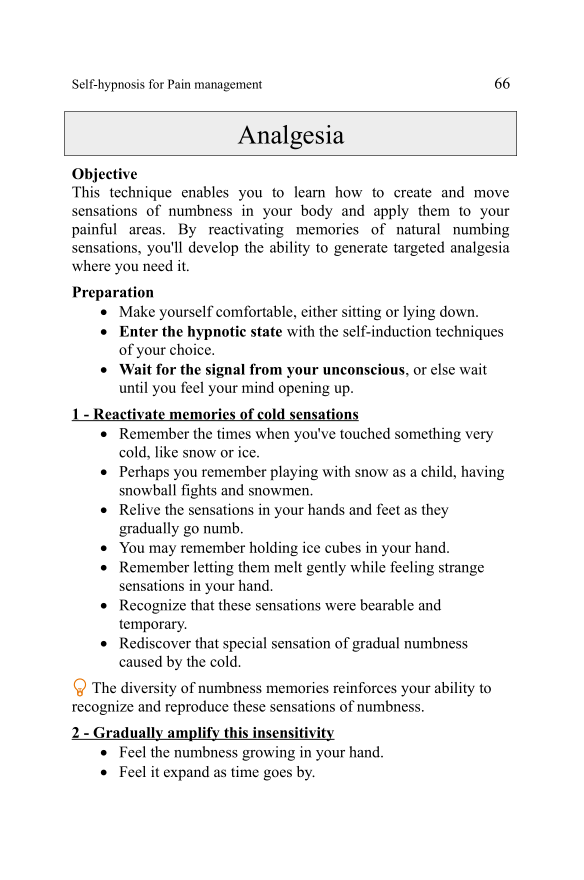
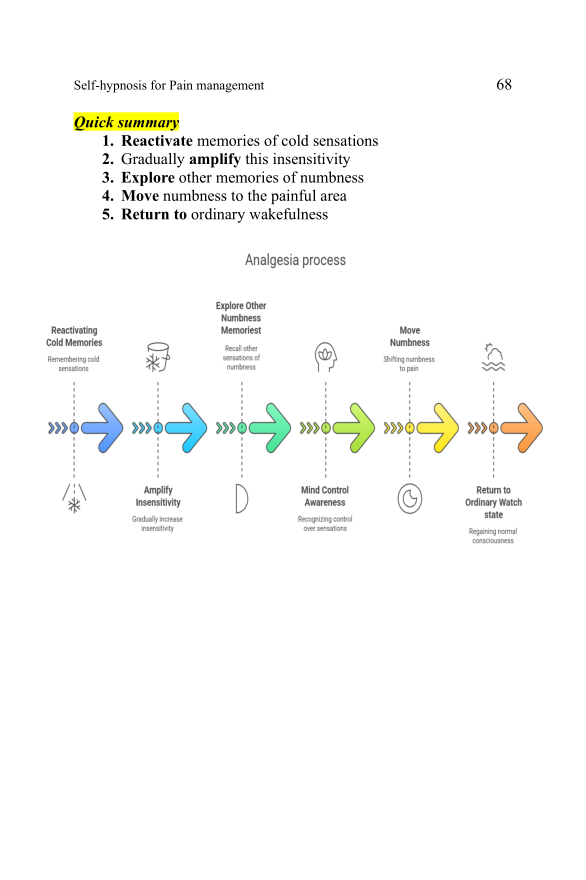
Excerpt from the book